It’s no joke.
A recent article in the FT, explained the costs of wealth management fees. The analysis was carried out by Numis. The results are below.
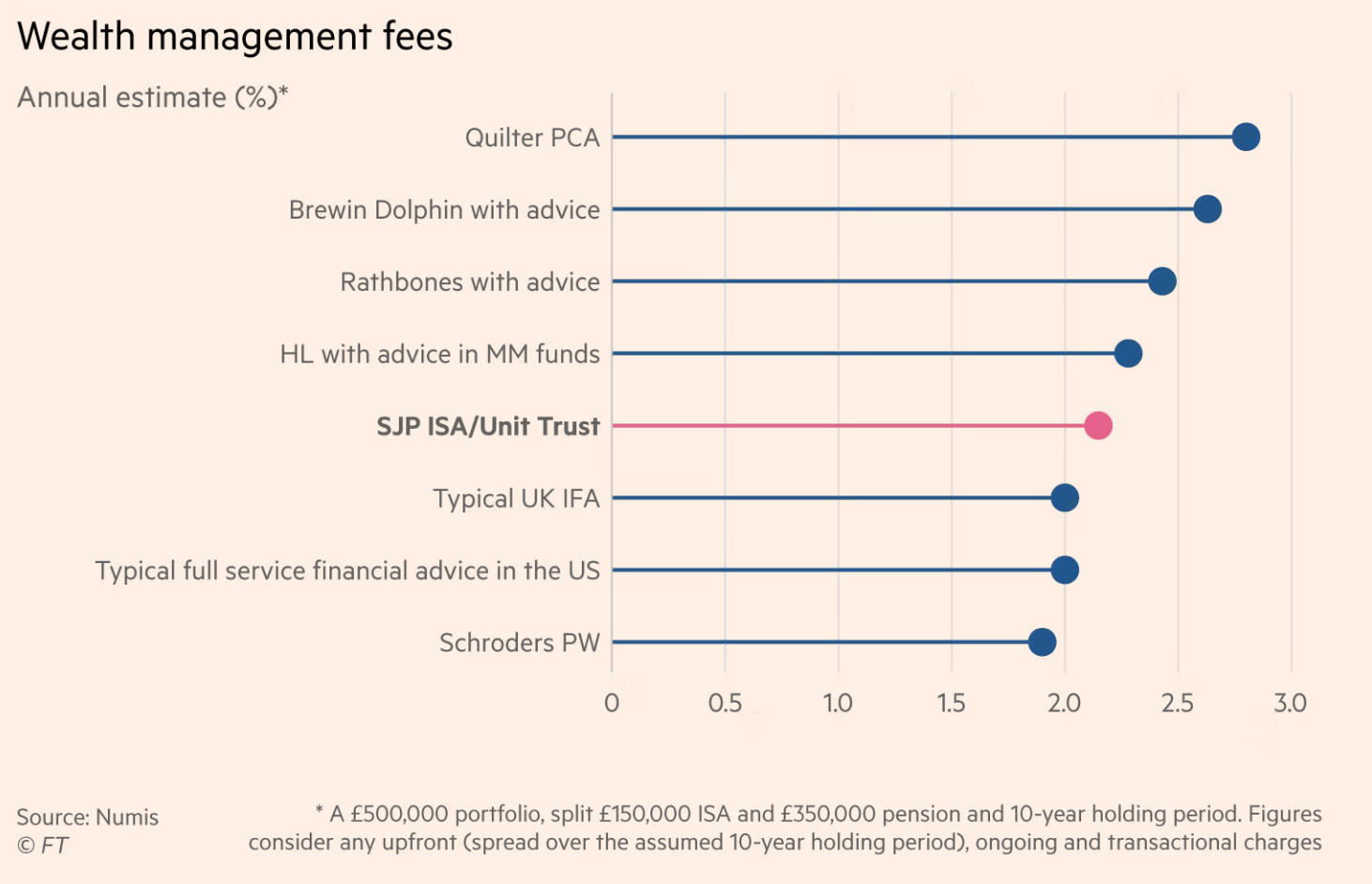
In our view, whilst the fees are high, the debate should be on value.
If a customer with Brewin Dolphin invested £500,000, the question an investor needs to ask is whether they are getting value. Of course, Brewin Dolphin would say unequivocally yes. But what does the customer think? Simply if Brewin Dolphin have thousands of customers, all prepared to pay their high fees, then those customers must be satisfied. The logic is that if they were not satisfied, they would take action and probably exit Brewin Dolphin. Of course, this argument presumes the investor is cognizant of Brewin's proposition.
In other words, do Brewin's customers really understand the fees they are paying and exactly what they are paying for?
If Brewin Dolphin are setting out their proposition to outperform, and quite frankly if you are going to pay them over 2.5% per annum, that’s what they should be doing, are customers really clear about performance? If Brewin Dolphin is making you say 25% each year, paying 2.5% each year may seem a bargain. If the number is 7% and you are paying them 2.5%, that is a massive part of the return you are giving away.
In all probability, customers are not clear about fees or performance. If they were clear, why would they remain with Brewin?
For customers who don’t fully understand whether they have achieved outperformance on a risk-adjusted basis, it may be time to reassess alternatives.
However, no one should jump ship until they have carried out impartial due diligence on their existing portfolio. As you will see in the summary above, jumping ship from Brewin to Rathbones, is a little like the expression, jumping out of the frying pan into the fire.
Clearly, as we are impartial advisers and Brewin Dolphin are not, (which is something you need to understand why not), the evidence is clear. High fees impact performance Negatively.