The seven-year rule is one of the simplest and most misunderstood inheritance tax rules in the UK. People talk about it as though everything magically disappears after seven years, but that is not quite true.
If you want to pass on wealth to family during your lifetime, it is worth understanding how the rule really works, what counts as a gift, and when it applies.
What the seven-year rule means
The idea is straightforward. If you make a gift to someone and survive for seven years, that gift is usually outside your estate for inheritance tax purposes.
These are called Potentially Exempt Transfers (PETs). They are “potentially” exempt because they only become fully exempt if you live for seven years after making them.
If you die within those seven years, the gift is added back to your estate to see if inheritance tax is due.
When taper relief applies
Taper relief is one of the most misunderstood parts of the seven-year rule. It does not reduce the value of the gift itself, and it does not apply to every gift made within seven years of death.
It only applies if the total value of gifts made within seven years before death exceeds the nil-rate band (currently £325,000). In other words, if the combined gifts stay below that threshold, there is no inheritance tax to pay and no taper relief to apply.
If the total does exceed the nil-rate band, then taper relief can reduce the tax due on the excess based on how long you lived after making the gifts:
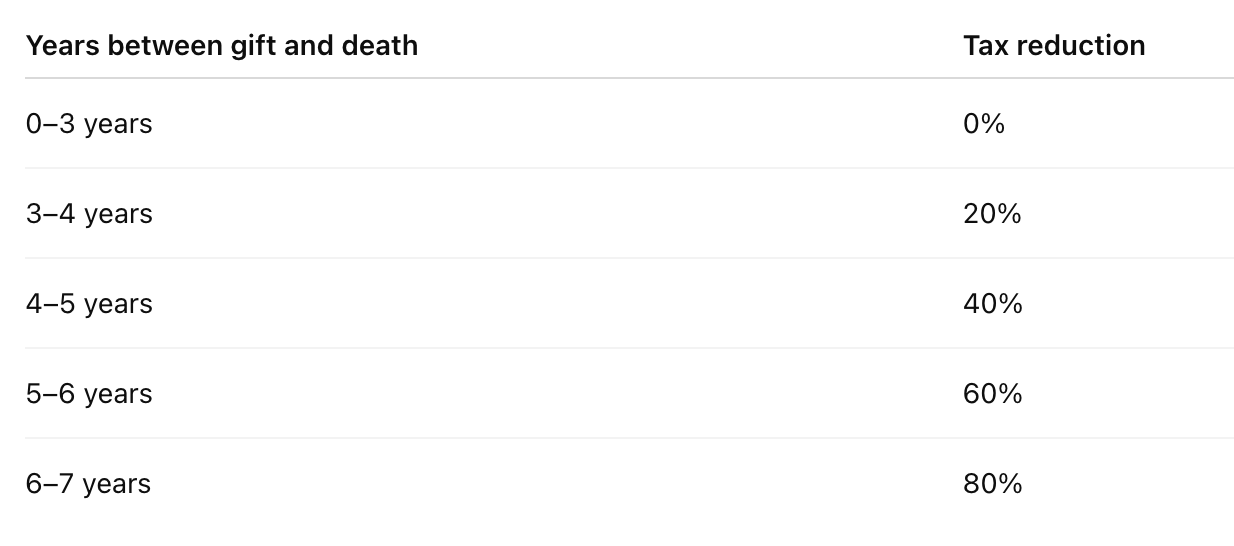
This distinction matters. Many people believe that surviving four or five years always gives partial relief, but that is only true for large gifts that exceed the nil-rate band. For most families, taper relief is rarely relevant.
What counts as a gift
A gift can be almost anything of value that you give away without getting something of equal value in return. That includes:
- Cash transfers
- Shares or investments
- Property or land
- Paying off someone’s debt
If you continue to benefit from what you have given away, it might not count as a genuine gift. For example, if you give your home to your children but continue to live there rent-free, HMRC can treat it as still part of your estate. This is known as a gift with reservation of benefit.
Regular gifts from income
Some gifts are immediately exempt and do not rely on the seven-year rule. Regular gifts made out of your surplus income can be free from inheritance tax straight away, as long as they do not affect your standard of living.
This rule is often overlooked but can be very powerful. For example, grandparents helping grandchildren with school fees or rent can use this exemption year after year without creating a seven-year clock each time.
Keeping good records
It is vital to keep clear records of any gifts you make. Note the date, amount, and recipient, and ideally keep copies of bank statements or letters confirming what was given.
This helps your executors later and reduces the risk of disputes with HMRC.
If you make larger gifts, it can also help to include them in your will paperwork or estate plan, so everything is transparent.
Common pitfalls
Giving away assets you still use. HMRC will challenge these as gifts with reservation.
Forgetting about earlier gifts. The seven-year clock resets each time you make a new one.
Ignoring your own cash flow. Giving too much too soon can create problems later.
Good planning balances generosity with personal security.
A simple example
Margaret gives her daughter £100,000 in 2025. She lives until 2033. Because she survived eight years, the gift falls completely outside her estate, saving potential inheritance tax.
Had she died after five years, taper relief would not apply because the gift is within the nil-rate band. Only if her total gifts in the previous seven years exceeded £325,000 would taper relief come into play.
Bringing it together
The seven-year rule rewards forward planning. The earlier you start, the more flexibility you have. Keep records, be realistic about what you can afford to give, and understand when the clock resets.
You do not need to be wealthy to benefit, only organised. Each gift made today can quietly reduce tomorrow’s inheritance tax bill, provided it is done properly.
If you want to understand how gifts fit into your estate plan and make sure you are using the right exemptions, book a 20-minute inheritance tax review.
Or subscribe to our newsletter for weekly insights.
Nic Round is a Chartered Financial Planner and Chartered Wealth Manager, authorised and regulated by the Financial Conduct Authority.